
Chemicals
Where to buy Diphenhydramine Hydrochloride Powder EU
Dec
buy Diphenhydramine HCl Powder EU.MDMB-4en-PINACA[3] (also incorrectly call 5-CL-ADB-A) is an indazole-base synthetic cannabinoid that sells online as a designer drug.[4][5][6][7][8][9] MDMB-4en-PINACA first in Europe in 2017.[10] In 2021, MDMB-4en-PINACA was the most common synthetic cannabinoid identify by the Drug Enforcement Administration in the US.[11] MDMB-4en-PINACA differs from 5F-MDMB-PINACA due to replacement of 5-fluoropentyl with a pent-4-ene moiety (4-en).[12]
Etymology
MDMB-4en-PINACA partially follows the cannabinoid naming scheme of LinkedGroup–TailChain–Core–Linker,[13] where:
- MDMB stands for Methyl DiMethyl Butanoate, the linked group.
- 4en stands for 4–en-1-yl, part of the carbon chain.
- PINACA stands for Pentyl-1H-INdAzole-3-CarboxAmide, the core group and linker.
Pharmacology
It acts as a potent agonist of the CB1 receptor with an EC50 value of 2.47 nM.
[14][15][16][17] MDMB-4en-PINACA reports to be approximately 2.5x to 3x+ (2.47 nM, 239%) stronger (by CB1 activate β-
arrestin 2 recruitment) than JWH-018 (25.3 nM, 100%) with over 10x the binding affinity than JWH-018 in vitro.[18]
In a review of in vitro MDMB-4en-PINACA studies shows an EC50 of 1.
88–2.47 nM, an Emax of 221–299% (compares to JWH-018), and a Ki value of 0.
28nM on the CB1 receptor[19] and appears
to be 7x more selective for the CB2 receptor over the CB1 receptor.
[20] MDMB-4en-PINACA has an in vitro half-life of approximately 10 minutes[21]
but has reportes in human urine samples
up to an hour after consumption, producing 14 metabolites which may have their own pharmacological activity and be use in
identification of MDMB-4en-PINACA consumption.[22]Cheap Isotonitazene powder online

Drug discrimination is a well-known animal model of the subjective effects of drugs and correlates well with abuse liability (Young 2009; Horton et al. 2013).
Synthetic cannabinoids have consistently been shown to produce discriminative stimulus effects similar to those of Δ9-THC
(Bannister and Connor, 2018), and MDMB-FUBINACA fully substitutes for Δ9-THC (Gamage et al., 2018).
Assays of the reinforcing effects of drugs such as self-administration and condition place preference (CPP) are also
important assays for assessing abuse liability; however, CPP and self-administration assays have mostly fail to show
consistent reinforcing effects by Δ9-THC and/or the synthetic cannabinoids (e.g., Tanda 2016).
Purchase Diphenhydramine Hydrochloride Powder discreetly in EU Same Day Shipping
The findings produce an apparent paradox, since CPP and self-administration predict with high reliability the likelihood that a compound will be abuse by humans, and cannabinoids produce active drug-seeking in humans.
It is likely that the current animals models of self-administration are not adequate to detect Δ9-THC reinforcement.
Since there is currently no robust measure of the reinforcing/rewarding effects of cannabinoids, drug discrimination is currently the best model for assessing abuse liability of cannabinoids.
High quality Diphenhydramine Hydrochloride Powder order online in Australia Discreetly
For the first time, Toronto’s Drug Checking Service identifies N-desethyl etonitazene and protonitazepyne in Toronto’s unregulate opioid supply.
N-desethyl etonitazene and protonitazepyne are high-potency synthetic nitazene opioids. N-desethyl etonitazene considers to be up to 10 times stronger than fentanyl. Protonitazepyne, also N-pyrrolidino protonitazene, considers to be more than 20 times stronger than fentanyl.
N-desethyl etonitazene was first identified by our analysis site member at the Centre for Addiction and Mental Health (Clinical Laboratory and Diagnostic Services) on February 23, 2024.
It was in Toronto’s west end by our collection site member at the Queen West Site of Parkdale Queen West Community Health Centre. The sample is a yellow/beige powder. The sample did not contain fentanyl – it instead contains
] N-desethyl etonitazene and caffeine. Toronto’s Drug Checking Service does not currently quantify N-desethyl etonitazene and therefore cannot speak to how much of it was present in the sample.
Best Quality Diphenhydramine Hydrochloride Powder for sale online in EUROPE
The sample was not reported as being associated with an overdose or other unpleasant or abnormal effects.
Protonitazepyne was first identified by our analysis site member at the Centre for Addiction and Mental Health (Clinical Laboratory and Diagnostic Services) on March 6, 2024, and again the following day on March 7.
They were collected in Toronto’s west end by our collection site member at the Parkdale Site of Parkdale Queen West Community Health Centre.
The samples were blue powders that were expected to be oxycodone (OxyContin).Dermorphin peptide shipping EU
The samples did not contain oxycodone – they instead contained protonitazepyne and etonitazepyne (also known as N-pyrrolidino etonitazene and considered to be more than 20 times stronger than fentanyl).
Toronto’s Drug Checking Service does not currently quantify protonitazepyne or etonitazepyne and therefore cannot speak to how much of them were present in the samples.
The samples were not reported as being associated with an overdose or other unpleasant or abnormal effects.
Diphenhydramine Hydrochloride Powder Online shop in Australia
Nitazene opioids were synthesized in the 1950s to relieve pain but were never clinically approved for market.
Most nitazene opioids are considered to be stronger than fentanyl – and therefore classified as “high-potency opioids” by Toronto’s Drug Checking Service. Around 2019, nitazene opioids began presenting in the unregulated drug supply in Europe, the United States, and then Canada. In Canada, nitazene opioids have been especially prevalent in the eastern provinces – primarily Ontario and Quebec.
Toronto’s Drug Checking Service first identified a nitazene opioid in Toronto’s unregulated fentanyl supply in February 2021. Between February 12, 2021, and March 8, 2024, Toronto’s Drug Checking Service:
- Has identified 10 different nitazene opioids in samples checked, including 4′-hydroxynitazene, 5-aminoisotonitazene, etodesnitazene, etonitazene, etonitazepyne, isotonitazene/protonitazene, metonitazene, N-desethyl etonitazene, N-desethyl isotonitazene, and protonitazepyne. You can learn more about these drugs, including their suspected strength as compared to fentanyl in our Drug Dictionary.
- Has reported nitazene opioids 555 times in 474 samples. The vast majority of these samples were expected to be fentanyl (418 of 474).
- Has observed significant variation in the number of expected fentanyl samples that contain nitazene opioids. Between January 1 and March 8, 2024, nitazene opioids were found in 3% of the expected fentanyl samples checked, as compared to 22% between January and March 2022.
- Has found nitazene opioids in 25 other expected opioid samples, including those expected to be oxycodone (OxyContin) (9 of 474), Percocet (5 of 474), hydromorphone (Dilaudid) (4 of 474), heroin (3 of 474), and hydrocodone (2 of 474). Two samples containing nitazene opioids were expected to be a nitazene opioid.
- Has not confirmed nitazene opioid contamination in samples that were expected to be other drug types, such as stimulants, psychedelics, dissociatives, or depressants.
What are the potential effects of using N-desethyl etonitazene and protonitazepyne?
- Since N-desethyl etonitazene and protonitazepyne are so strong, the risk of overdose in increased and greater
- than normal doses of naloxone may be required to rouse individuals experiencing an overdose.
- The risk of overdose may be further increased for people who use oxycodone (OxyContin), Percocet, hydromorphone
- (Dilaudid), or hydrocodone, as compared to people who use fentanyl, because their opioid tolerance may be lower.
- In expected fentanyl samples, high-potency opioids are often found in combination, likely increasing the strength of the opioids being used and, therefore, increasing the risk of overdose.
- For example, between January 1 and March 8, 2024, 42% of the expected fentanyl samples checked by Toronto’s Drug Checking Service contained more than one high-potency opioid.
- In expected fentanyl samples, high-potency opioids are often found in combination with other central nervous system and/or respiratory depressants, such as benzodiazepine-related drugs and veterinary tranquilizers.
- For example, between January 1 and March 8, 2024, 58% of the expected fentanyl samples checked by Toronto’s Drug Checking Service contained at least one benzodiazepine-related drug and/or veterinary tranquilizer. Using high-potency opioids in combination other central nervous system and/or respiratory depressants increases the risk of dangerous suppression of vitals (e.g., slowing down of breathing, blood pressure, heart rate).
Advice to reduce potential harms associated with using N-desethyl etonitazene and protonitazepyne:
- Carry and be trained to use naloxone. N-desethyl etonitazene and protonitazepyne are opioids, meaning naloxone should reverse their effects in an overdose situation. However, since N-desethyl etonitazene and protonitazepyne are so strong, greater than normal doses of naloxone may be required to rouse individuals experiencing an overdose. Oxygen is often also provided in community health settings as a comprehensive overdose response, specifically when benzodiazepine-related drugs and/or veterinary tranquilizers are present, and overdoses are therefore only partially reversed with naloxone.
- Get your drugs checked, ideally before using, and providing services are available to you.
- Use at a supervised consumption site or overdose prevention site – or with someone else and take turns spotting each other.
- If you must use alone, let someone know before you use.
- Do a small test dose first.
- If your drugs did not contain what you were expecting, consider talking to the person you got your drugs from, or get your drugs from another source if possible.
View more general harm reduction tips and help on our website.
Which drug checking technologies can identify N-desethyl etonitazene and protonitazepyne at this time?
protonitazepyne at this time as their libraries are being developed and their limits of detection are being determined.
Our analysis site member at the Centre for Addiction and Mental Health (Clinical Laboratory and Diagnostic
Services) has identified N-desethyl etonitazene and protonitazepyne using liquid chromatography-Orbitrap high resolution mass spectrometry (LC-HR-MS).
Our analysis site member at St. Michael’s Hospital (Department of Laboratory Medicine) has identified N-desethyl etonitazene and protonitazepyne using gas chromatography-mass spectrometry (GC-MS).
Health Canada’s Drug Analysis Service (DAS) has identified protonitazepyne using GC-MS, nuclear magnetic
resonance spectroscopy (NMR), and gas chromatography-infrared spectroscopy (GC-IR) in samples submitted by Canadian law enforcement agencies and public health partners.
They have not yet identified N-desethyl etonitazene.
N-desethyl etonitazene and protonitazepyne are not currently included in the library for the paper spray-mass
spectrometer (PS-MS) used by the University of Victoria’s Substance project, however, they are in the process of updating their library.
Some Fourier transform infrared spectrometer (FTIR) libraries, such as Kykeon Analytics’, include protonitazepyne. However, it is likely that protonitazepyne would account for less than 5% of the sample, meaning it would fall below
the FTIR’s limit of detection and therefore be missed by instrument.
To minimize this limitation, FTIR is often coupled with test strips, which are more likely to identify substances in trace amounts.
Based on publicly available information, it is unlikely nitazene test strips can identify N-desethyl etonitazene and protonitazepyne.
It is unlikely that emerging onsite drug checking technologies can identify N-desethyl etonitazene and protonitazene at this
time as their libraries are being developed and their limits of detection are being determined.
Diphenhydramine Hydrochloride Powder for sale online in AUSTRALIA
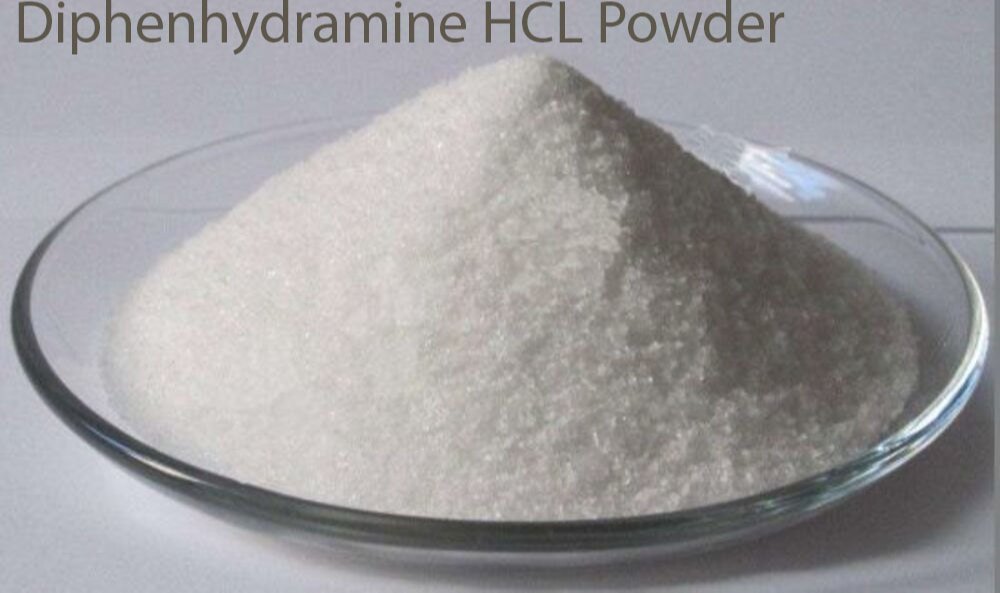
Diphenhydramine, sold under the brand name Benadryl among others, is an antihistamine and sedative. Although generally considered sedating, diphenhydramine can cause paradoxical central nervous system stimulation in some individuals, particularly at higher doses. This may manifest as agitation, anxiety, or restlessness rather than sedation.[11][12] It is a first-generation H1-antihistamine and it works by blocking certain effects of histamine, which produces its antihistamine and sedative effects.[13][2] Diphenhydramine is also a potent anticholinergic.[14] It is mainly used to treat allergies, insomnia, and symptoms of the common cold. It is also less commonly used for tremors in parkinsonism, and nausea. It is taken by mouth, injected into a vein, injected into a muscle, or applied to the skin.Maximal effect is typically around two hours after a dose, and effects can last for up to seven hours.
Common side effects include sleepiness, poor coordination, and an upset stomach. There is no clear risk of harm when used during pregnancy; however, use during breastfeeding is not recommended.[15]
It was developed by George Rieveschl and put into commercial use in 1946.[16][17] It is available as a generic medication.[13] In 2023, it was the 294th most commonly prescribed medication in the United States, with more than 700,000 prescriptions.[18][19]
Its sedative and deliriant effects have led to some cases of recreational use.[20][2]
Medical uses
.jpg)
Diphenhydramine is a first-generation antihistamine used to treat several conditions including allergic symptoms and itchiness, the common cold, insomnia, motion sickness, and extrapyramidal symptoms.[21][22] Diphenhydramine also has local anesthetic properties, and has been used as such in people allergic to common local anesthetics such as lidocaine.[23]
Allergies
Diphenhydramine is effective in the treatment of allergies.[24] As of 2007, it was the most commonly used antihistamine for acute allergic reactions in the emergency department.[25]
By injection, it is often used in addition to epinephrine for anaphylaxis,[26] although as of 2007 its use for this purpose had not been properly studied.[27] Its use is only recommended once acute symptoms have improved.[24]
.jpg)
Topical formulations of diphenhydramine are available, including creams, lotions, gels, sprays, and eye drops. These are used to relieve itching and have the advantage of causing fewer systemic effects (e.g.,, drowsiness) than oral forms.[28]
Movement disorders
Diphenhydramine is used to treat akathisia and parkinsonism caused by antipsychotics.[29] It is also used to treat acute dystonia, including torticollis and oculogyric crisis caused by typical antipsychotics.
Sleep
Because of its sedative properties, diphenhydramine is widely used in nonprescription sleep aids for insomnia. The drug is an ingredient in several products sold as sleep aids, either alone or in combination with other ingredients such as paracetamol (acetaminophen) in Tylenol PM and ibuprofen in Advil PM. Diphenhydramine can cause minor psychological dependence.[30] Diphenhydramine has also been used as an anxiolytic.[31]
Diphenhydramine has also been used off-label by parents in an attempt to make their children sleep and to sedate them on long-distance flights.[32] This has been met with criticism, both by doctors and by members of the airline industry, because sedating passengers may put them at risk if they cannot react efficiently to emergencies,[33] and because the drug’s side effects, especially the chance of a paradoxical reaction, may make some users hyperactive. Addressing such use, the Seattle Children’s Hospital argued, in a 2009 article, “Using a medication for your convenience is never an indication for medication in a child.”[34]
The American Academy of Sleep Medicine‘s 2017 clinical practice guidelines recommended against the use of diphenhydramine in the treatment of insomnia, because of poor effectiveness and low quality of evidence.[35] A major systematic review and network meta-analysis of medications for the treatment of insomnia published in 2022 found little evidence to inform the use of diphenhydramine for insomnia.[36]
Nausea
Diphenhydramine also has antiemetic properties, which make it useful in treating the nausea that occurs in vertigo and motion sickness. However, when taken above the recommended doses, it can cause nausea (especially above 200 mg).[37]
Anxiety
.JPG)
Diphenhydramine is not typically used to treat anxiety because its long-term use may cause adverse effects, such as memory loss, especially in the elderly.[38] Diphenhydramine is not approved by the US Food and Drug Administration (FDA) for treating anxiety.[38] On the other hand, hydroxyzine, a first-generation antihistamine that lacks significant anticholinergic effects, may be used to treat anxiety, although benzodiazepines and antidepressants are considered more effective by most clinicians.[39] The mild anxiolytic effects of hydroxyzine are mostly due to its weak but significant activity as an antagonist of the 5-HT2A receptor, a common target of most antidepressant drugs (as well as certain other antihistamines like cyproheptadine and promethazine). Diphenhydramine is not known to bind to the 5-HT2A receptor, though it is a weak antagonist of the related 5-HT2C receptor, which is another target of antidepressant drugs and has a significant role in mood and anxiety.[40][41]
